Real Time Resampling in FPGAs
It is often necessary to import a
44.1-kHz signal from sound cards into 48-kHz or 96-kHz systems.
Other typical sources include consumer electronics products. In
the digital domain, it is not readily possible to resample the
signal directly, as the period intervals are too coarse. A modern
FPGA runs only about 100 times faster than the audio sampling
rate.
Conversion
Circuit
With this resampler circuit it is possible to create 48kHz and 96kHz audio data in 24 Bit in realtime by synchronizing an incoming data stream and using a combination of upsampling, interpolation and filtering. In the image below, a block diagram is presented:

In data stream is interpolated with a modified LaGrange-filter using
integer-only operation to avoid divisions.
The filter is 4 times
oversampled to obtain a fine curve to resample at the new frequency.
Using 98,x Mhz and appropriate divisions the relationship of the
441 : 1920 can be maintained.
Interpolation Filter
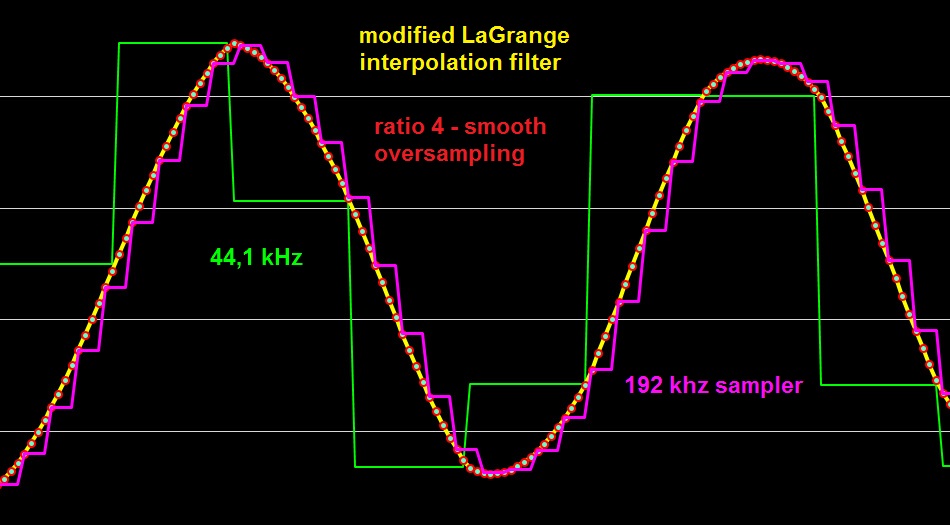
The filter interpolates the data between the low-frequency sample
values and provides practicyll any intermediate coordinates with
16-bit precision. The bending of the curve by adjacent points is
taken into account. A following low-pass filter set to approximately
24 kHz (16 kHz for 48-k systems) reduces anti-aliasing. This is
essential for eliminating the artifacts of Lagrange interpolation
and make is useable for audio applications.
Conclusion
Interpolation filters in PLDs and FPGAs can be used
to easily interchange data from consumer and professional mixing
consoles without external
chips or resamplers.